
The Beatitudes – Cause for Examination

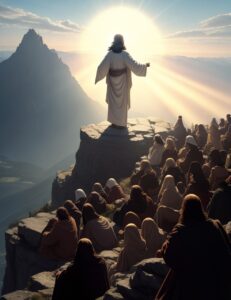
AI-generated image for Sermon on the Mount

AI-generated image for Sermon on the MountHopefully, as we have examined the Beatitudes from Matthew 5:1-12, the conversation has made clear that the passage is not discussing a future expectation or a set of causal characteristics to which we should some day aspire. While the first four statements are indeed attitudes, they are neither casual nor optional for those who would lead a faithful life. These verses describe what it means to have a heart that is obedient to God. Furthermore, the following three verses (Matthew 5:7-9) describe the actions of someone fully committed to being a child of God.

Ideally, the “blessed” statements are leading us to an intense and truthful self-examination. Sometimes we tend to identify specifically with one of the beatitudes without realizing that, together, they describe our character and our actions. We need to start thinking of Matthew 5:1-12 as a summary of what it means to be a Christian. The passage is both progressive (a pattern for growth) and conclusive – if we actually pattern our lives after these verses, we find the complete guidance needed for life. This guidance is not found exclusively in the passage; instead, the verses provide instructions that enable us to understand our situation, know what to do about it, see where to turn, and then learn how to live. It makes clear the value of God’s word and also warns of the challenges faced by those who do live faithfully in this lost and dying world.

Following the statements of Matthew 5:1-12, Jesus continues for another chapter and a half in what we commonly call the Sermon on the Mount. In the chapters of Matthew 5-7 is recorded the greatest sermon of all time, with each successive lesson elaborating on the pattern that is to be our lives. However, all of the lessons of Matthew 5:13-7:27 are summarized in the Beatitudes. As we examine ourselves against that pattern, we can then move on to the detailed instructions given in the balance of the sermon. Jesus speaks on: 1) our influence to the world; 2) Christ as fulfillment of the Law; 3) sin is not just physical, it begins as a spiritual issue; 4) the sanctity of marriage; 5) the value of integrity; 6) how to pray; 7) that which is truly valuable, and; so much more.

As we continue studying these “blessed” statements, are we carefully coloring in our lives with Jesus’s words as the lines to stay within? As children with a coloring book, we often stray outside those lines. The question we must answer is: do we go back to the pictures we have already colored and purpose in our hearts to stay closer to the inside lines next time?


The Beatitudes – Blessed Are Those Who Mourn​

AI-generated image for Sermon on the Mount

How often do we read a passage from Scripture and think that it sounds so opposite from what we would expect? Such seems to be the case with Matthew 5:4 Blessed are those who mourn, For they shall be comforted. How could it be that being in mourning could be a blessed thing?

Most often, the immediate answer lies with an understanding that we are not God. The greatest our knowledge and wisdom can reach pales in comparison to that of God Almighty. In 1 Corinthians 3:19, we read, For the wisdom of this world is foolishness with God. We repeatedly see in the Bible that man’s arrogance leads to misunderstanding, because we think we know when, in fact, our understanding is still so limited. When God’s Word tells us something that doesn’t seem right, there are two possibilities – we haven’t studied enough to comprehend the Scripture fully, or we neglect to acknowledge (or remember) that God knows so much more than we do. Hopefully, we tend toward the former rather than the latter; I worry about being arrogant when it comes to faith and spirituality.

When Scripture tells us that those who mourn are blessed, if it seems strange, we need to study to reconcile our thinking to God’s truth. In our Matthew 5 passage, the word translated as “mourn” is the strongest Greek word for mourning. The word is associated with the most overwhelming sadness, often over matters of loss or personal condition. I believe it is the latter use that Jesus intended when he spoke the Beatitudes.

In verse 3, we examined how “poor in spirit” was a reference to our spiritual condition without God and Christ – destitute and without hope. We have also talked about how reading through the Beatitudes (Matthew 5:1-12) is a sort of progression of the Christian life (beginning, growth, maturing and trials). With these realizations, it is natural to see Jesus move from discussing the poor in spirit (those who see their absolute need for God) to those who are mournful over the sinful condition of their lives. Many faithful Christians can describe the moment when they realized their need for Christ’s salvation (poor in spirit) and, with equal force, discuss the gut-wrenching sorrow (mourning) over the sinful life they have led.

When 2 Corinthians 7:10 tells us we cannot truly repent without godly sorrow, it is natural to see the progress from understanding our state to mourning over our condition. As He lists the other Beatitudes, Jesus tells how this process is good. He teaches us that, although painful, the mourning is good and necessary, and it is not the end of the cycle. As we often say, read to see the entire context, not just the single verse. But even this single verse is a powerful teaching: those who mourn over their condition in a way that leads them to Christ will be spiritually blessed.


The Beatitudes – Introduction

AI-generated image for Sermon on the Mount

AI-generated image for Sermon on the MountWhile I understand the motivation behind the statement, it is shortsighted to view the Beatitudes merely as attitudes. It seems equally problematic when someone considers the text of Matthew 5:1-12 as a discussion of separate people. We can also find people who view the text as a reference to something yet to come. But the fact of the matter is that Jesus is describing something much more in the beginning of the Sermon on the Mount.

When Jesus lists those who are blessed, He is actually listing the characteristics (the defining traits) that separate children of God from the rest of the world. Jesus is describing what is required of us if we are truly going to submit to the will of God. We can also see this as a progression of sorts with the verses forming 1) the beginning of faith, 2) the growth of faith, 3) the maturing of faith and finally 4) the trials of faith. When we read and study what has become known as the Beatitudes, we are seeing the purest explanation of what it takes to be an obedient Christian. Christ’s words go further and pronounce the specific, albeit spiritual, rewards of an obedient life.

The Beatitudes outline several traits on which we should base our lives, and then tell us of the rewards: heaven, comfort, fulfillment, mercy, and an eternal relationship with God. The listing of these traits and rewards also shows that, with God, rewards are spiritual. That doesn’t mean that physical life holds no pleasure for the faithful, but it should instill in us an understanding that our heavenly home is the ultimate promise. To live in glorious perfection, without pain or sadness, in the presence of the Almighty, is a goal worth whatever costs we encounter.

Ironically, while those who heard Jesus teach immediately recognized that He taught “…as one having authority…” (Matthew 7:29), that is not the world’s reaction today. In the Beatitudes, Jesus explained the law we now focus on. Through the study of this great sermon and other New Testament scriptures, we find divine guidance for a life pleasing to God. And yet, man tries either to ignore God’s word or to add to it. As we consider the text, let us each put aside our opinions, rely solely on the Bible for guidance and work to integrate these attitudes not as occasional feelings, but as pervasive, all-controlling traits of our faithful lives.

Modern or Outdated?

Image of Train Signal Hardware - Print by Martin Kent Miller

Image of Train Signal Hardware - Print by Martin Kent MillerIn Acts 24, when Paul stood accused before Felix, the Jews brought a Roman orator, Tertullus, to make their case against the apostle. In verses 5-6, the Bible records a portion of Tertullus’ speech, “For we have found this man a plague, a creator of dissension among all the Jews throughout the world, and a ringleader of the sect of the Nazarenes. He even tried to profane the temple, and we seized him and wanted to judge him according to our law.

If we consider this example and many of the other points of conflict between Christ and the Jewish leadership of His day, we come to realize that, in part, the Jews accused Jesus and the early Christians of modernism. They saw them as challenges to the traditions they had created for themselves and, rather than working to understand the Gospel’s core message, they clung tightly to those traditions. While the Jews of the first century followed a faith based on the Old Testament, their practices were a far departure from what God had given initially to Moses at Mt. Sinai. Through the ages, they had built for themselves a system they liked, a model that gave certain people extraordinary influence, enriching those in positions of power.

Ironically, today, much of the world is convinced of just the opposite. Many people in the world around us view faith as outdated, resistance to change or even anti-progress. They view us as either superstitious or backward because we trust the Bible more than modern philosophy and so-called science. The accusations could not be further from the truth, because many of the ideas that are embraced as modern are actually false. The Bible and science are fully compatible when viewed with an honest perspective. Unfortunately, scientific “discovery” is often influenced by whoever is paying for the discovery. If modern ideals are examined, they fall generally into two categories: those that offer some degree of success because they are either based on Scripture or at least do not violate God’s Word, or those that ultimately fail because they are against God’s will.

As a person of faith, it can be hard to understand how so many (often educated) people can miss this point. They embrace modernism (not the kind of which Tertullus accused Paul), scoff at us, and are then amazed when the world’s condition continues to decline. So what are we to do? First, learn the Word of God. We can’t give a defense if we don’t understand the text on which we base our faith. Two, when prepared, invite skeptics to examine the Word. It has withstood the test of centuries of disbelief. Three, be ready in season and out (2 Timothy 4:2) to discuss matters of faith and your commitment to following Christ.

Isn’t it interesting to see how Satan reads the room to determine just how to deceive mankind?